
Unmanned vehicles, crop-spraying drones and blue-light weed killers were some of the emerging technologies exhibited at the 2025 Hart Field Day.
Alongside the usual showcase of improved farming methods, ag tech enjoyed the spotlight on Monday with dozens turning out for live demonstrations.
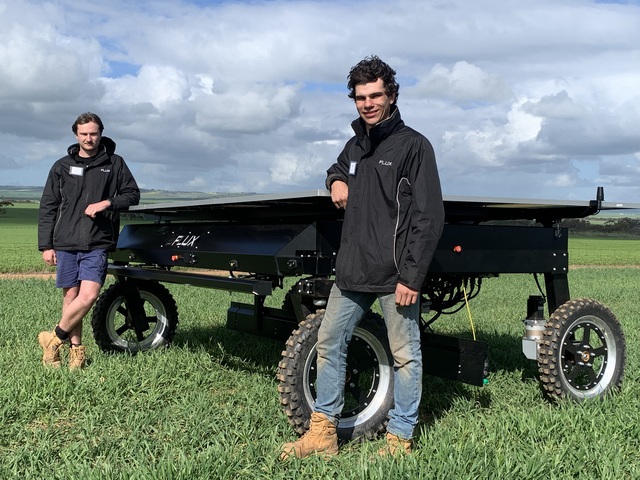
South Australian firm Flux Robotics demonstrated the Rover, a self-driving, solar-powered machine designed to detect and spray weeds without human oversight.
Project engineer Jordan Howard said the main drawcard, based on feedback from farmers, was the input cost savings on chemical and preserving crop quality as a result of “increased precision”.
“Where it’s used will depend on the individual farm, but we envision it being mostly used from post-harvest to canopy closure,” Mr Howard said.
The Rover has been on the market since August and is leased at $20,000 per year. It can cover approximately ten hectares a day and a 200 hectare block in 20 days.
Mr Howard said with further research and development, the Rover could also be used for “chipping” weeds out with no need for chemical – an ordinarily labour-intensive job.
“I think it definitely is something that when you look forward to 20, 30 years’ time, people are imagining using those tools for their day-to-day work,” he said.
“Between now and then, I think it’s just figuring out what the path in the middle looks like.”
Drone tech company’s SA expansion
A Victorian company making drones for the agricultural sector said it is aiming to make in-roads with the South Australian market, inking a partnership with a local supplier.
At the Hart Field Day on Tuesday, Horizon Ag Tech displayed its DJI M350 model drone, one component of a system designed for automatically detecting and spraying weeds.
Founder Jim Dula, who started the company in 2024, said local firm Vater Machinery had begun stocking a demo model and would be a “first stop” for local enquiries.
The company has stores in Nuriootpa, Saddleworth and Kadina.
Mr Dula said many farmers viewed autonomous technology as a “novelty”, but perceptions were changing.
“I think it’s just new and not a lot of people are using it yet, but I’m trying to get more information out there to help people understand how it works,” he said.
The entire system, including mapping and spraying drones, and software, retails at approximately $60,000.
“If you’re using an expensive chemical, it’s costly to blanket spray the whole paddock,” he said.
“With our system, it might cost three or five dollars a hectare, but if you’re only spraying 30 per cent of the paddock, you’re saving money.”
Chemical alternatives get to root of problem
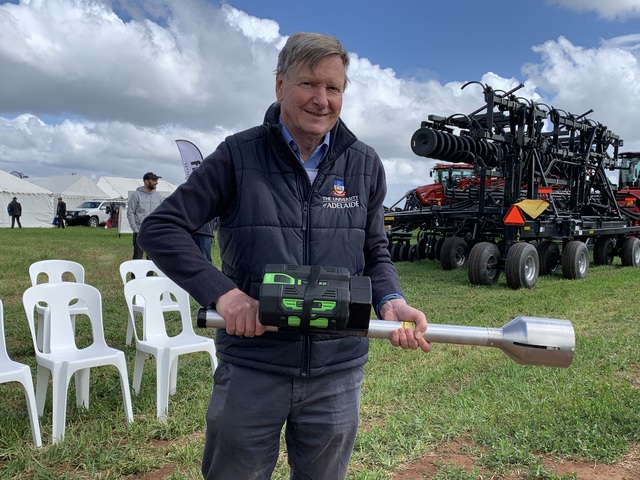
Researchers have been trialling lasers and electrocution to zap weeds, but University of Adelaide weed management expert Dr Chris Preston says a combination of blue light and heat is the safest non-chemical option.
At the Hart Field Day on 17 September, Dr Preston demoed a prototype appliance using the technology, which is being developed by private companies in the US.
Within five seconds of being lowered onto a garden-variety weed, the specimen began visibly wilting under a temperature of roughly 200 degrees celsius.
While it is already being slowly adopted in the horticulture sector, Dr Preston said more research was needed to deploy it at scale in commercial agriculture.
However, he said that adopting non-chemical weeding methods was important to curtail herbicide resistance in broadleaf weeds.
“All the technology is available, although when it comes to being able to automatically detect weeds, it still needs some refinement,” he said.
“It’s generally good at detecting weeds that are dissimilar to the crop, but wild vetch, or tares, which is a basically a breeding inhibitor for lentils, that’s harder because the leaves can look quite similar to lentil shoots.
“So, the question is, how do we get this to work across a large-scale farming operation of 100 hectares rather than five hectares.”
Dr Preston, an agricultural researcher of 35 years, said a commercial product would need to be “something that a farmer would actually use”, but it was too early to tell what that would look like.
– Content produced with support of the Australian Local News Resilience Project in partnership with the ABC, Deakin University and Griffith University and funded by the Australian Research Council.