
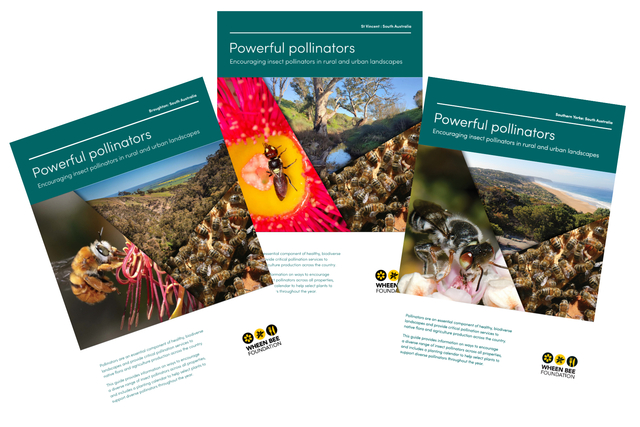
The Northern and Yorke Landscape Board (NYLB) has teamed up with the Wheen Bee Foundation and the University of Adelaide to create a region-first Powerful Pollinator Guides.
The guides aim to help landholders better understand and support the insects that increase yields and keep natural landscapes functioning.
The three guides cover the Broughton (Orroroo and south to Barossa Valley), Saint Vincent (Port Pirie south to Northern Yorke Peninsula and extending further south to Two Wells) and Southern Yorke (south of Ardrossan) bioregions.
They feature photographs, local knowledge and practical tips, including: how to attract and keep pollinators on your property all year, which pollinators are attracted to which plants, and why pollinators are essential for food production and biodiversity.
Commissioned by the Northern and Yorke Landscape Board, the guides were produced by expert botanists and field ecologists from the Wheen Bee Foundation and the University of Adelaide.
The Pollinator Guides provide information about each of the pollinator types that can be seen in the region, and how to identify them in nature.
Each guide features a list of local agricultural crops, forbs, shrubs and trees that can be planted to encourage pollinators onto local properties.
A recent scientific study on the Yorke Peninsula demonstrated the link between healthy roadside vegetation, pollinator populations and higher crop yields.
The study found that faba bean and canola crop yield and seed set significantly increased with proximity to healthy roadside vegetation due to pollinators living in these corridors.
NYLB resilient ecosystems ecologist Dr Elly Pratt said populations of insect pollinators were on the decline worldwide due to land clearing, pesticides and climate change.
She said the new guides provided important information about the critical role pollinators play in supporting agriculture and healthy ecosystems in the region, and that it is important to provide habitat year-round for pollinators, as they are an overall positive for farm productivity.
“It’s important that we understand what pollinators are doing for us because they are so important for food production, especially total yields, even though we often can’t see them at work,” she said.
“These guides are a great way to learn about how you can encourage these insects, particularly by planting pollinator-friendly plants in on properties and by protecting native roadside vegetation.”